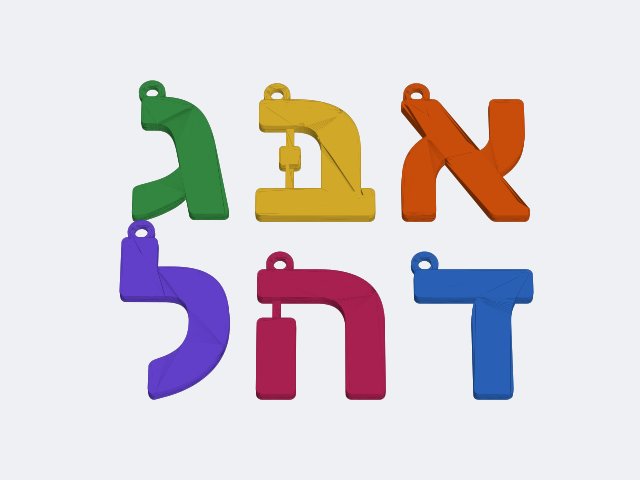
 Alef-Beis KeychainsPick the letters, font and size, and see every tile on the plate.Open design →
Silk PLA is shiny and looks beautiful on a menorah. On a keychain it breaks.
Why silk breaks
- Silk has extra additives that give it the shine. Its layers don't stick together as well as plain PLA.
- It is more brittle. A keychain gets bent, dropped and pulled all day, and the thin loop is the first thing to snap.
- The break almost always happens along a layer line at the ring hole.
What to use instead
- Plain PLA, PLA+ or matte PLA for keychains.
- PETG for one that lives on a backpack or car keys. It bends instead of snapping.
- Save silk for things that sit on a shelf: the menorah, the esrog, display pieces.
Tips for a stronger keychain
- Keep the loop thick. If you change the design, don't thin it out.
- Use 3 or more walls (perimeters) in your slicer.
- Print it flat on the plate, the way the file comes.
Short version: silk for show, plain PLA for anything that gets carried.
What you need
What you needBambu Lab A1 ComboWhat I print on. The AMS lite does 4 colours.↗Bambu Lab A1 miniSmall and easy. Prints one colour at a time.↗Bambu Lab P2S ComboEnclosed, faster, with the bigger AMS.↗Bambu Lab PLA Starter Pack4 × 1 kg with spools↗3DHoJor PLA 4-pack – Red, Yellow, Green, Blue4 × 1 kg · the bundle I use↗Bambu Lab P1S ComboEnclosed, 4 colours, a step below the P2S.↗ELEGOO Centauri CarbonEnclosed and fast for the price.↗Keychain rings (100 pack)↗Polymaker PLA – Yellow↗3DHoJor PLA 4-pack – Red, White, Black, Gray4 × 1 kg · the bundle I use↗ANYCUBIC Kobra XA cheaper way into 4-colour printing.↗Polymaker PLA – Blue↗SUNLU PLA 8-colour sampler8 × 250 g · try lots of colours↗Polymaker PLA – Green↗Polymaker PLA – Red↗
As an Amazon Associate I earn from qualifying purchases. It doesn't cost you anything extra.